I’ve always been passionate about gardening in a way that was both environmentally sound and sustainable. To me, gardening with a lot of harsh pesticides or herbicides is counter-intuitive. It’s like you’re trying to beat nature into submission, and is simply not for me.
My gardening ethos revolved around things like companion gardening, composting, and waste reduction/reuse. Then we found permaculture, which incorporated just about everything I’d ever found on my own, along with a myriad of other practices.
Permaculture is a bit of a buzzword, and it’s tough to say whether it’s a process, design/modelling system, or ethos. I think that it’s pretty much all of those things, and can be as complex or simple as you like.
Permaculture has three overarching ideals:
- Take care of the earth.
- Take care of the people.
- Share the surplus.
Under these are twelve design principles:
- Observe and interact.
- Catch and store energy.
- Obtain a yield.
- Apply self-regulation and accept feedback.
- Use and value renewable resources and services.
- Produce no waste.
- Design from patterns to details.
- Integrate rather than segregate.
- Use small and slow solutions.
- Use and value diversity.
- Use edges and value the margins.
- Creatively use and response to change.
Principles 3 through 8 had been pretty much my approach all along, so I felt right at home with this larger approach.
The information above is ripped off entirely from this site. It’s awesome.
My introduction to permaculture wasn’t plunging head-long into an approach with 12 complex principles. Rather, it was via Josh Byrne of Gardening Australia fame. You can find out more about Josh here and here. We love Gardening Australia, and I was lucky enough to get a DVD box set a few years back. At the risk of sounding wanky, it really did help develop our gardening approach, leading directly to a desire for self-sufficiency and where we find ourselves today.
Josh’s permaculture approach is described here. I’d also recommend the DVD where he takes a year or so to convert a quarter acre suburban Perth garden into a permaculture paradise. I think it might be this one. You can get that in a box set too. Mine is signed by Josh. I might have a bit of a gardening man crush on him. I’m not even joking.
Josh explained permaculture a lot more simply than the permaculture principles web site does. He basically said that it’s a way of thinking globally but acting locally for environmental sustainability. He also listed the fundamental aspects of a permaculture garden, and these were the things that we immediately adopted (if we didn’t have them already):
- Planning
- Poultry
- Worm farm
- Drip irrigation
- Grey water recycling
- Composting
- Mulching
We changed our own gardening to match the permaculture philosophy (I still see it as a philosophy) and the results were impressive.
We incorporated poultry, which is something every gardener should do, even if you’re in the suburbs. Your waste is just about eliminated by definition, as there’s very little they don’t eat. What they produce is pure gold, be it of the culinary kind (eggs) or the gardening kind (poop). Seriously, I see chooks as being one of our best gardening decisions ever.
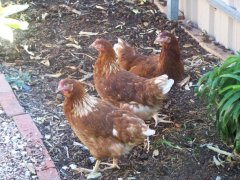
The Ladies!
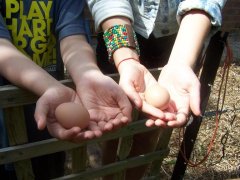
Eggs! The second best thing to come out of the chooks.
We made a worm farm. This can be done quite simply, and there are all kinds of guides on how to do it. Mine is quite small, but one of our next farm projects is expanding it to be bath sized. I’ll post about that when it happens.
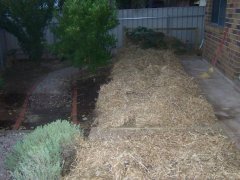
We changed our garden designs, reclaiming much of the yard as productive area or using available space to do things like grow potatoes under straw.
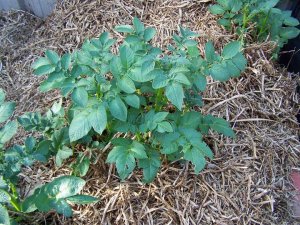
Spuds under straw.
We ended up with bumper crops all the time. Well, we ended up with bumper crops in summer. Winter was more of a challenge as our entire back garden was shaded, and that learning experience was fed directly into the design of our giant veggie patch in the new place.
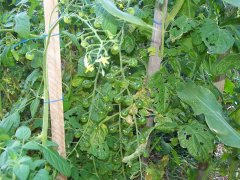
Volunteer tomatoes.
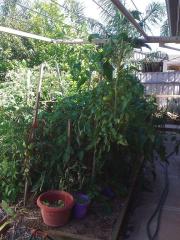
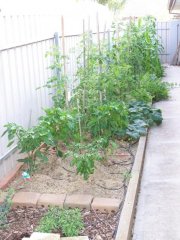
I ended up having to tie the tomatoes to the clothes line.
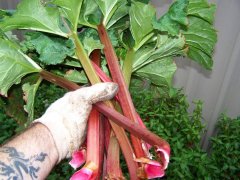
Rhubarb!
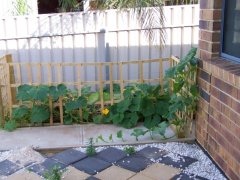
It ended up pulling down that fence and a gate.
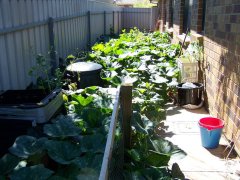
Yeah, I have no control over that at all.
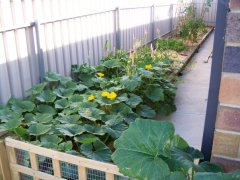
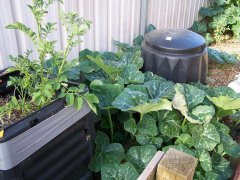
A pumpkin plant in the process of getting away from me.

Pumpkin!

Habanero. Lots of heat.

Lots ‘o corn.
This surplus is what led us to a couple of realisations. Firstly, we didn’t have to just eat this stuff seasonally, but could preserve it.

Bumper chilli crop!
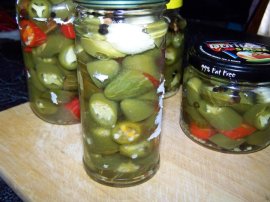
Pickled chillies, jalapenos mostly.
Secondly, we were producing enough of certain things that we’d never have to buy them again. For example, we eat a lot of chillies, and with little effort had enough chillies of the pickled, dried, and popper kind that we were chilli self-sufficient. We also had enough preserved fruit, jam, eggs, and even things like pumpkin to last us until the following season. We were self-sufficient for a heap of stuff, and I wanted more!
At the same time we had been looking at houses for four years or so. That started with me and my kids, and expanded to me and my gorgeous girlfriend Linhda. I should also mention that Linhda was a big part of the preserving that we experimented with, and are still experimenting with years on. She’s an amazing cook and is why I’m free to grow the things I grow.

Me and Linhda. She’s the pretty one on the right.
Anyway, we’d been looking at houses for a while, and our desire for a self-sufficient lifestyle completely altered our house requirements. All of a sudden it wasn’t about the house in the country; it was about the land.
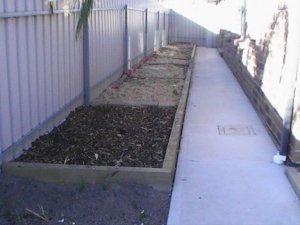







 The Atherton Farm Blog